

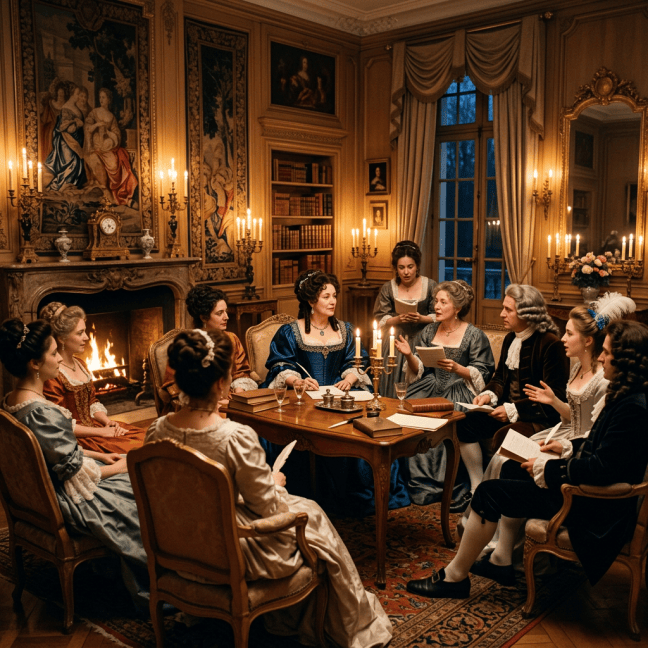
I found references to salons run by women in the Age of Enlightenment.
Madame de Pompadour (1721–1764) used her influence at the French court to support philosophers like Voltaire and foster intellectual exchange.
Germaine de Staël was another key salonnière, promoting Enlightenment ideals and offering platforms for thinkers.
Writers and Philosophers
Mary Wollstonecraft (1759–1797) authored A Vindication of the Rights of Woman (1792), arguing for women’s education and equality based on rational principles.
Marie le Jars de Gournay (1626) wrote The Equality of Men and Women, facing ridicule but pioneering feminist thought.
Anna Maria van Schurman, a Dutch scholar, corresponded widely in the “Republic of Letters,” connecting women intellectuals across Europe.
THE REPUBLIC OF LETTERS
I found the Republic of Letters to be a fascinating concept in the pre-internet area. It must have taken a lot of time and effort to write and exchange those letters. Maintaining the thread of conversation without using hashtags must have been a challenge. Did they label or colour code envelopes with the topic of discussion.
I’m sure women with an intellectual bent of mind excluded from mainstream education found a tool to evolve by sharing.
EXCERPTS FROM A FEW OF THOSE LETTERS
“Why should the female sex be excluded from the study of letters? Have they not a rational soul as well as men?”
Anna Maria van Schurman (Dutch scholar, 1607-1678)
“I am imprisoned, but my mind is free, and I will not cease to write against tyranny.”
Arcangela Tarabotti (Venetian nun, 1604-1652)
“I write to you as I breathe, without effort, without pause.”
Madame de Sevigne (France, 1626-1696)


Nice take on the prompt, Reena as I like where you went with this. Despite the barriers of being confined to traditional domestic roles and being excluded from formal universities and political life, women during the age of enlightenment actively shaped intellectual discourse, ran influential cultural spaces, made breakthroughs in science, and laid the foundational arguments for modern feminism. Elite women in Paris and London ran private drawing-room gatherings where philosophers, scientists, and politicians debated radical new ideas. Figures like Madame Geoffrin and Julie de Lespinasse acted as intellectual brokers, editors, and patrons who directly steered the flow of Enlightenment thought. Maria Sibylla Merian became a pioneering entomologist and botanical illustrator. Émilie du Châtelet became a mathematician and a physicist. Laura Bassi became the first woman to have a doctorate in science, and the second woman in the world to earn the Doctor of Philosophy degree.
LikeLike
Those salons were quiet revolutions, women didn’t hold official power, so they created spaces where minds could meet instead.
LikeLike