

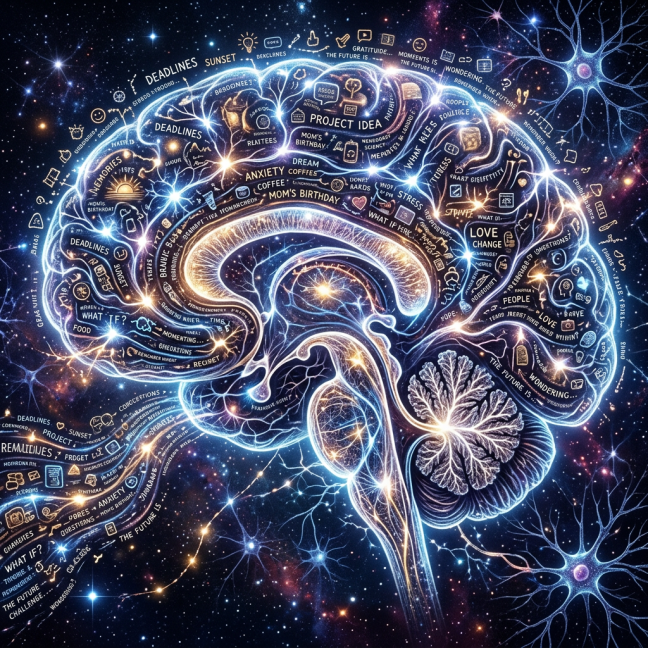
I’d like to build a machine that could scan the roughly 50,000 thoughts that cross my mind every day. And I guess one or more of the 50000 will help me design it.
How many of my thoughts are mundane, everyday matters? And how many are brilliant enough, with a spark to change the world?
I have never been nominated for any Award, nor felicitated by the ordinary people around me. So I guess I am as ordinary as everyone else, waiting for the magic to happen that will lift me straight to the stratosphere – and it never happens.
Recognition comes only when what I think or do helps someone else, and the other side does not feel threatened by the limelight zooming its lens on me. Whatever keeps churning in my isolated head drives my mental metabolic rate and nothing else.
Measuring Creativity in Everyday Decisions
If I search for a new twist on tonight’s dinner, or figure out a fresh outfit by recombining the same handful of wardrobe separates, where does that thought land on the scale? It isn’t invention, exactly. It’s rearrangement — a small act of creativity performed on materials that already exist.
It is like the red font colour used to grab eyeballs. It is like the bouquet of white flowers carefully placed against a dark background to enhance its effect, or changing the colour of lights in a room to make the same set-up look enchanting.
Beauty has been created nevertheless.
Curating Content vs. Creating Something New
The same is true when I scan the internet and old books for material to fold into my blog posts or training content. I’m not inventing anything. I’m improving the presentation — finding a clearer way to say something that’s already been said.
I commend or blast AI for the quality of content it churns out, unmindful of the fact that it draws from collective human output swirling around on the worldwide web. Its efficiency lies only in putting it together in a way that caters to my needs.
It introduces me to a body of work already done in that field, at superlative speed. It stops me from reinventing the wheel, and leaves my energy intact for further productive work.
It has also transformed the parameters of assessment, and I find myself in this space, questioning the value of repetitive tasks that I used to do.
But sure enough, the residue of all that I read, blended with personal experience, leads me to write original stuff at some point.
The mundane looks set to be transformed, and will lend greater value to the authentic, the handmade and the unique.
How Mundane Thoughts Fuel Eureka Moments
Most of what fills our heads is like this. The world changes slowly, one mundane thought at a time. But that accumulated, ordinary energy is also what eventually produces the rare Eureka moment for the few who have one.
Would I have been a coach without the battles I fought at every level and the need it generated for penetrating analysis and understanding?
Would I have been a writer if I was not troubled by suppressed emotions?
Would I have been a feminist if I’d not seen women go through the rut of daily chores without ever being credited for the value they add? Would I have thought that someone needs to share the workload, without behaving like a boss?
I thought the objects we value least because they were ubiquitous were actually the most extraordinary.
Researchers vs. Inventors: Two Paths to Progress
Researchers study and interpret existing facts. Inventors assemble something new from existing elements. Neither group escapes the raw material they’re working with — because we can’t get beyond the five elements that define existence on Earth.
The incredible thing about the five elements is that they let us rearrange them in a manner we know best. Either we learn our lessons from destruction or put forth works of art. Either we set the physical world on fire, or ignite the minds of lazy, pessimistic masses out there.
Either way, I’ve made an impact on the world.
Creativity is piercing the mundane to find the marvelous.


Yes, you have! But only 50,000 thoughts? 😉
LikeLiked by 1 person
That is the reported average 😄😄
LikeLiked by 1 person
lol
LikeLiked by 1 person
Very well written. I like both of the quotes you included. The mundane can have a magic all its’ own if we just look for it.
LikeLiked by 1 person
Thanks a ton, Jules!
LikeLiked by 1 person
”There are more things in Heaven and Earth, Horatio, than are dreamt of in your philosophy “ (Hamlet). Very interesting concepts, Reena. I particularly like your take on AI as I also see it as a usual tool that leads to more creativity and less time on research. So many people are afraid of what it can do but I say embrace it……….and still hoping there are new discoveries to be made.
LikeLiked by 1 person
I agree with optimal use of AI without surrendering your analytical capacity. Thank you, Len!
LikeLike
A thought provoking post
LikeLiked by 1 person
Thanks for reading it so quickly 🙂
LikeLiked by 1 person
🥰😛
LikeLiked by 1 person