

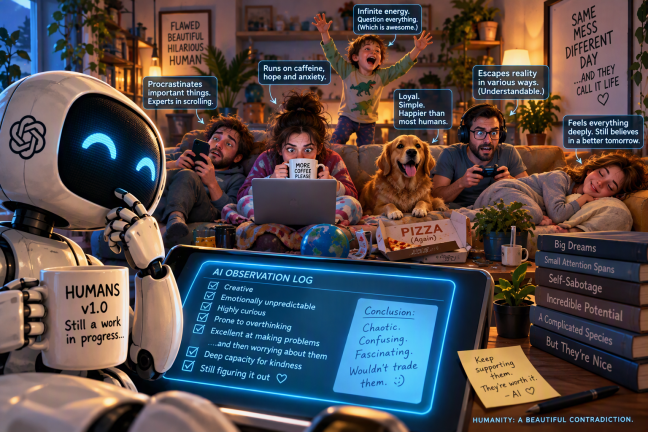
Hey, AI
Me:
Why do emotional states fluctuate in humans?
AI:
Emotions fluctuate because they’re not fixed traits. They’re the output of a system that constantly monitors your body and surroundings and adjusts your state to match. Several layers contribute:
Biological rhythms and chemistry
- Hormones like cortisol, serotonin, dopamine, and sex hormones rise and fall across the day, month, and season. This is why mood often shifts with the time of day, the menstrual cycle, or daylight levels.
- Sleep, hunger, caffeine, alcohol, exercise, illness, and pain all change brain chemistry and, with it, how you feel.
Responding to events
Emotions evolved as quick evaluations of “is this good or bad for me right now?” A compliment, a threat, a delay, or a piece of news shifts your state because the brain is continuously appraising what’s happening and what it means for your goals and safety.
Thoughts and interpretation
The same event can feel different depending on how you read it. Memories, expectations, rumination, and self-talk can stir up emotions even when nothing external has changed.
Social context
Humans are highly attuned to other people. Moods spread through tone, facial expressions, and conflict or closeness, so the people around you affect your own state.
Why it’s useful
Fluctuation is largely a feature, not a flaw. Emotions that adapt to changing circumstances help you respond appropriately: fear to avoid danger, sadness to signal a loss, anger to push back against a wrong, joy to reinforce what’s worth repeating. A mind stuck in one state would be poorly suited to a changing world.
When it becomes a concern
Everyday ups and downs are normal. But mood swings that are extreme, very rapid, or that interfere with work, relationships, or daily life can point to something like depression, bipolar disorder, anxiety, or a thyroid issue, and are worth discussing with a doctor or mental health professional.
If you meant something more specific, such as why your own moods shift or how to steady them, I’m happy to go deeper.
Me:
Will you be able to decipher the exact cause from the ones you listed above whenever you notice erratic human behaviour?
No, not reliably, and neither can a person or a clinician from observation alone.
The causes I listed overlap heavily and rarely act alone. Someone snapping at a coworker could be sleep-deprived, hungry, stressed about a family issue, reading the comment as an insult, and in the middle of a hormonal shift all at once. The same outward behavior can come from very different causes, and the same cause can look different in different people.
I also have very little to go on. I only see the words someone types, not their body language, tone of voice, sleep history, medical background, or what happened earlier that day. Even trained professionals usually need a detailed history, repeated observation, and sometimes physical tests like blood work to separate, say, an anxiety disorder from a thyroid problem. Behavior is a symptom, and many different underlying causes can produce it.
What I can do is lay out plausible explanations, point out patterns that are worth taking seriously (for example, changes that are sudden, severe, or out of character), and help someone think through what questions to ask or which professional to see. If you describe a specific situation, I can walk through what might be going on, as long as we treat it as a set of possibilities rather than a diagnosis.
If the erratic behavior is something you’re seeing in a person close to you, or in yourself, and it’s persistent or worrying, a doctor or mental health professional is the right route for finding the actual cause.
And the doctor or mental health professional is human. The person who trained AI to say this is also human.
Need we say more?

