


The book title that inspired this is “The Road Less Travelled” by M. Scott Peck.
Taking a particular road, is always a deliberate choice.
The busiest highways of life are so densely populated, due to the perceived security of being in known territory. But known to whom? The travellers are stepping on that ground for the first time. They trust the experience of others who have preceded them. We seek traffic updates from people who are moving ahead of us, or from a GPRS/satellites/drones watching the road from above.
Here, we operate with different mind-sets:
1. Follower
One is to believe that the experience of people in the close vicinity benefits us. This is what we do, when we accept guidance from others with gratitude, or conform to the norms laid down by our ancestors or mentors.
2. Student
Another is to believe in an entity, which is detached from the field of action, and is an independent observer. We study the works of experts (scientists, analysts and philosophers), and try to equate their observations with our experience. Here, the expert is viewing the same reality as that of our co-travellers on the road, albeit from a distance, and deriving conclusions by applying their own logic to it.
These experts could comment on the environment of both the roads, not necessarily the busy one.
3. Explorer
The third option is to tread a path, not explored or less explored by others. No data or evidence of good or bad is available on the subject. A fear of the unknown could hold us back, or a love for adventure could propel us. We accept the uncertainty, and open ourselves up to a new experience. We also open ourselves up to failure. People could read about an accident on a hazardous path tomorrow, or flock there to salute a trailblazer. The road might not remain the one less travelled.
4. Leader
Yet again, do we wish to travel on the road less taken, and share our experiences with the world later? Do we wish to be a leading driver on the road, but on a less populated route? Do you wish to establish your leadership in a new domain?
5. Ascetic
A few might say that they want to experience it for their own sake, and then disappear into oblivion. That is the path of the ascetics, the yogis who do not return to the world they once lived in.
6. Nailed by determinism
What happens, when there is only one way ahead? This situation is often created by those who desire to dominate and control.
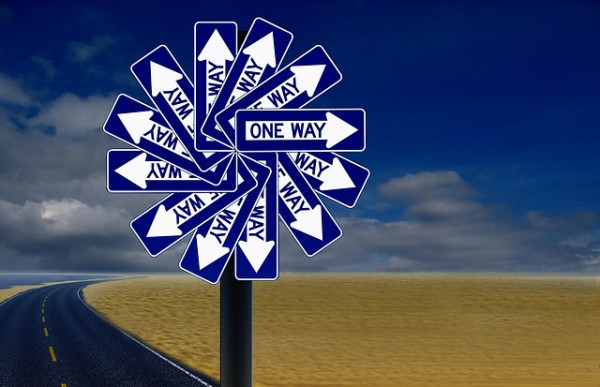
It could also be a deterministic mind-set.
the doctrine that all events, including human action, are ultimately determined by causes regarded as external to the will. Some philosophers have taken determinism to imply that individual human beings have no free will and cannot be held morally responsible for their actions.
Source: Wikipedia
Will the path be accepted as inevitable, or will one take the trouble to construct a new road? The physical and mental resources within reach, will determine the same.
7. Choosing not to make a choice
The choice of turning back, or to stay rooted at the same place emanates from a need for security and self-preservation. This is not entirely a regressive or negative mind-set. People do it to protect their livelihood, or health or physical safety.
It is about surviving, not thriving or decimating. It may also be to survive long enough, to move ahead later. It may be to take the time to reflect, and then, make a choice. It can be a suspended state of animation, not stillness or decay or death.
SUCCESS AND FAILURE
So, all choices in life are ultimately about the following
- Anticipation of success or failure
- Calculated risk on the probability of success or failure
- Acceptance of varying degrees of success or failure
Success and failure are both relative terms. One slides back or forth on a continuum, and the judgemental remarks of others, emanate from a relative position of expectations.
We exercise a choice of taking a particular road, based on
- what we look forward to doing,
- what constitutes a comfort zone for us.
- what we expect to encounter on that road.
- how connected we are to our external environment
- the level of alignment between our internal and external environment.
THE ULTIMATE RESULT
The ultimate result of all these choices is where we find ourselves today. We have created our sense of self, our identity and our station in life, after making these choices one at a time. It did not feel phenomenal at that point of time, but formed a complex maze, throwing us about in different directions, and finally landing where we are.
Yet, this is not final. This is not the end. There are choices ahead.
 Creative Experiments and More
That title says to me that we should choose our own way and not follow the herd. As in ” I march to the beat of a different drummer.”
LikeLiked by 2 people
If following the herd is justified, so be it! That becomes YOUR path.
LikeLiked by 1 person
It depends on one’s temperament. It is good that some do not want to follow along because that is how we have new discoveries and creativity. But we need to follow along in agreeing on rules to live by so we don’t all run around like anarchists. 🙂
LikeLiked by 2 people
This book by Peck has always stuck with us. He nails it in “The Road Less Traveled” and is fundamental to anyone wanting to have a blessed relationship. Great post.
LikeLiked by 2 people
Thank you! I found ‘The Road Less Travelled’ getting stuck at a point. It was not able to provide solutions.
LikeLiked by 1 person
Oh, that’s unfortunate. I found a lot of meat in it. There are sooooo many wonderful books like it, each with a different twist to chew on.
LikeLiked by 1 person
The Five Love Languages by Gary Chapman is another eye-opener.
LikeLiked by 1 person
Yes it is. Truly a book to bring to life ones commitment to their mate. Another one is by Eggerichs “Love and Respect”.
LikeLiked by 1 person
Hey Reena,
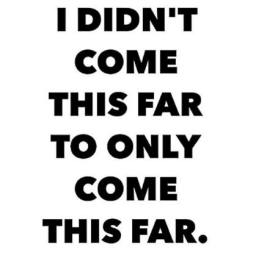
Thank you for posting an insightful read. I enjoyed engaging with the content and reflecting upon its worth, especially the closing graphic, which had me twisting like a Klein bottle. Depending on ones spiritual beliefs, I wondered how many times one might encounter those words whilst walking along a road forever leading to eternity?
Enjoy your weekend. Take care.
Namaste 🙂
DN
LikeLike
Thanks for the generous compliments, Dewin! I am glad that it struck a chord with you.
LikeLiked by 1 person
My pleasure Reena. Thank you for engaging blogging 🙂
Namaste
DN
LikeLiked by 1 person
Reblogged this on BrewNSpew and commented:
Sharing great read by Reena.
LikeLiked by 1 person
Thanks for the reblog!
LikeLiked by 1 person
You’re welcome and others are enjoying it.
LikeLiked by 1 person
Excellent read, Reena. Reblogging.
LikeLiked by 1 person
Thank you so much!
LikeLiked by 1 person